

Key Takeaways
Our Verdict
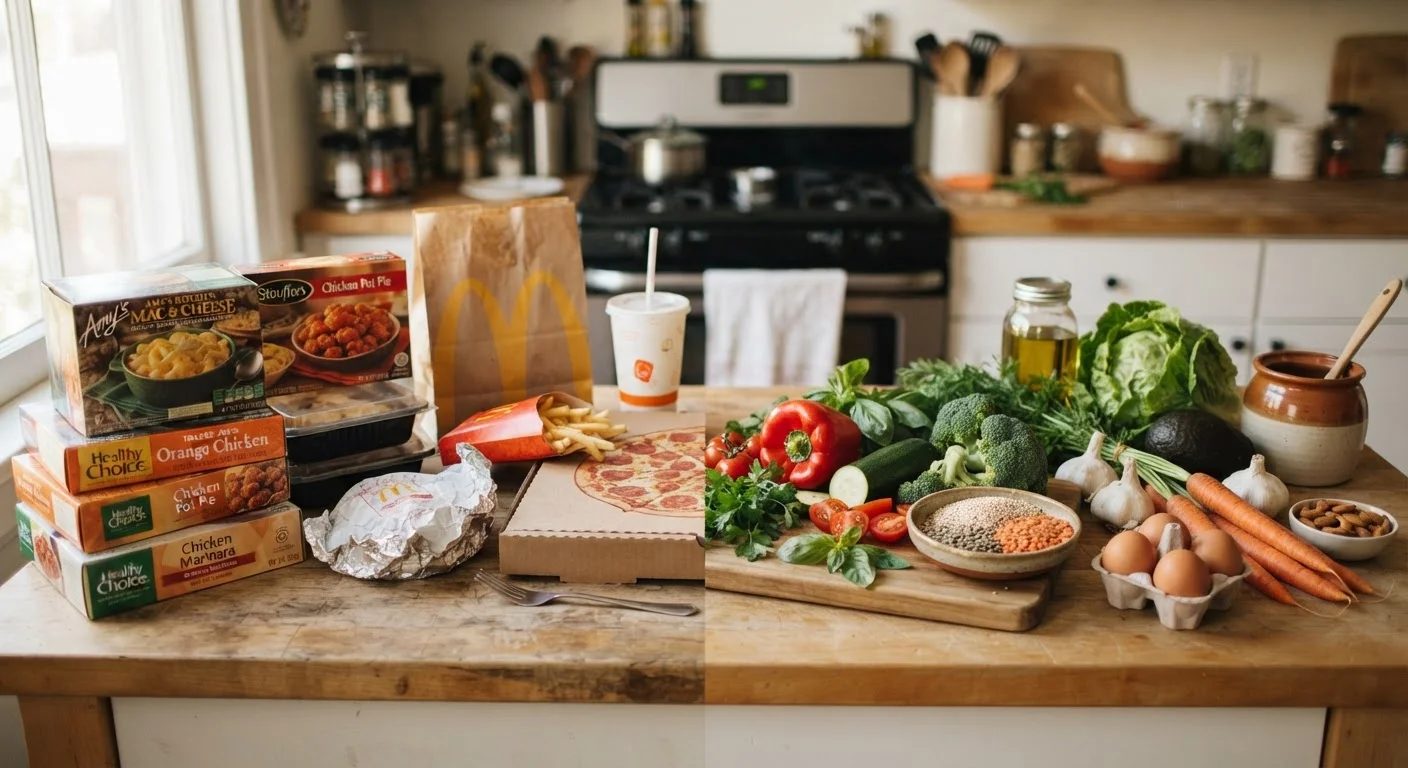
Home cooking from basic ingredients costs less and delivers better nutritional value than relying on packaged convenience foods, across nearly every meal category. The gap is widest for dinners and lunches, where processed options carry the steepest markups. Families who cook even a few meals per week from staple ingredients can see meaningful reductions in both grocery spending and daily sodium and saturated fat intake.
| Best for | Recommended |
|---|---|
| Families with tight grocery budgets seeking the most nutrition per dollar | Home cooking from staple ingredients |
| Households managing sodium intake or chronic health conditions | Home cooking from staple ingredients |
| Very busy households needing occasional no-prep meals | Selective use of lower-sodium convenience items |
| Families transitioning away from heavy convenience food reliance | Hybrid approach combining batch cooking with limited convenience items |
What the numbers actually show on cost per serving
USDA Economic Research Service data places the average cost of a home-cooked dinner for a family of four at roughly $4 to $6 total, depending on the recipe and regional food prices. A comparable packaged or frozen entree for the same family typically runs $10 to $15 or more. That gap compounds over weeks and months.
Consider a simple example: a pot of chicken and vegetable soup made from a whole chicken, dried beans, carrots, celery, and onion might cost $5 to $7 for six servings. A comparable canned or frozen soup product for the same number of servings often costs $12 to $18. The markup on convenience is not marginal; it is substantial.
Breakfast shows a similar pattern. A box of individually portioned instant oatmeal packets costs two to three times more per serving than a container of plain rolled oats that takes the same number of minutes to cook on a stovetop. You are paying primarily for packaging and portioning, not for different nutritional content.
For families trying to get the most from a tight budget, the evidence on food costs and nutrition quality makes a strong case that scratch cooking is far more economical than it is often perceived to be.
| Processed convenience foods | Home cooking from staples | |
|---|---|---|
| Average cost per serving (dinner) | $2.50 to $4.00 per person | $1.00 to $1.75 per person |
| Sodium per serving | Often 600 to 1,200 mg | Controllable, typically 100 to 400 mg |
| Added sugars and refined starches | Frequently high | Low when using whole ingredients |
| Preparation time | 5 to 15 minutes | 20 to 40 minutes active or passive |
| Shelf life and waste | Months, but cost per item is fixed | Variable; bulk staples reduce waste |
| Nutritional control | Fixed by manufacturer formulation | Full control over ingredients |
| Skill required | None | Basic cooking skills sufficient |
Nutritional trade-offs families should understand
Processed convenience foods are formulated for shelf stability, palatability, and fast preparation. Achieving those goals generally requires higher levels of sodium, saturated fat, added sugars, and refined starches. The CDC notes that Americans get a large proportion of their daily sodium from packaged and processed foods, with many single-serving items exceeding 800 milligrams of sodium, which is more than a third of the recommended daily limit for most adults.
Home cooking gives families direct control over those variables. Using the same base ingredients, a family can prepare a dish with a fraction of the sodium simply by skipping added salt or using low-sodium broth. That control matters especially for households managing blood pressure, heart health, or weight-related concerns. This article provides general nutritional information and is not medical advice; consult a qualified healthcare professional for guidance on dietary needs specific to your family's health conditions.
It is worth noting that not all convenience foods are equally poor nutritionally. Plain frozen vegetables, canned beans (rinsed), and plain canned fish are convenience items that carry reasonable nutritional profiles at low cost. The concern applies most to multi-ingredient packaged meals, processed meats, and snack foods. See our comparison of frozen and fresh produce for a closer look at where frozen products hold up well.
Time is real, but its cost is often overstated
The most common defense of convenience foods is time. Packaged meals are fast. That is true, but the time difference between a convenience meal and a simple scratch meal is frequently smaller than families assume.
A pot of rice and lentils with sauteed vegetables takes about 30 minutes of mostly passive cooking time. A pasta dish with canned tomatoes, garlic, and ground meat takes 25 minutes. These are not elaborate recipes; they are the kind of low-skill, low-ingredient meals that make up the core of home cooking for most families. Batch cooking compounds the time advantage further: cooking a double portion of grains or beans on Sunday afternoon creates ready-to-use components for three or four weeknight meals. Our comparison of batch cooking and meal kits goes deeper on realistic time expectations for families with packed schedules.
The hidden time cost of convenience foods is also worth accounting for. Frequent grocery runs to restock packaged items, plus the time spent managing food waste when processed items expire quickly, chip away at the time savings that packaging promises.
Families who identify two or three reliable simple recipes and rotate them regularly reduce the cognitive load of cooking substantially. That kind of routine is what makes home cooking sustainable, not a perfectly varied meal plan.
Building a realistic middle ground
Few families cook every meal entirely from scratch, and there is no practical reason to aim for that. The question is where to draw the line between convenience and home cooking to maximize both savings and nutrition without creating unsustainable demands on household time.
A workable approach for most families involves keeping a set of inexpensive staple ingredients on hand at all times: dried or canned legumes, whole grains like oats and brown rice, eggs, frozen vegetables, and canned fish. These items are cheap per serving, nutritionally dense, and have long shelf lives that reduce waste. Our household reference for affordable whole foods covers typical costs and nutritional profiles for these staples in detail.
Convenience items that make sense to keep selectively include plain frozen vegetables, canned beans, low-sodium canned tomatoes, and plain rolled oats. These provide speed without the sodium and cost markup of fully processed meals.
The items worth pulling back on are multi-ingredient frozen entrees, packaged seasoning kits, single-serving snack packs, and processed lunch meats. Cutting these out or sharply reducing their frequency is where most families find the largest savings. For a closer look at grocery spending habits that quietly add up, see common mistakes that inflate food budgets.
This article is for general informational purposes only and does not constitute medical, nutritional, or financial advice. Consult a qualified healthcare professional or registered dietitian before making significant dietary changes, particularly if you or a family member has an existing health condition.