

Key Takeaways
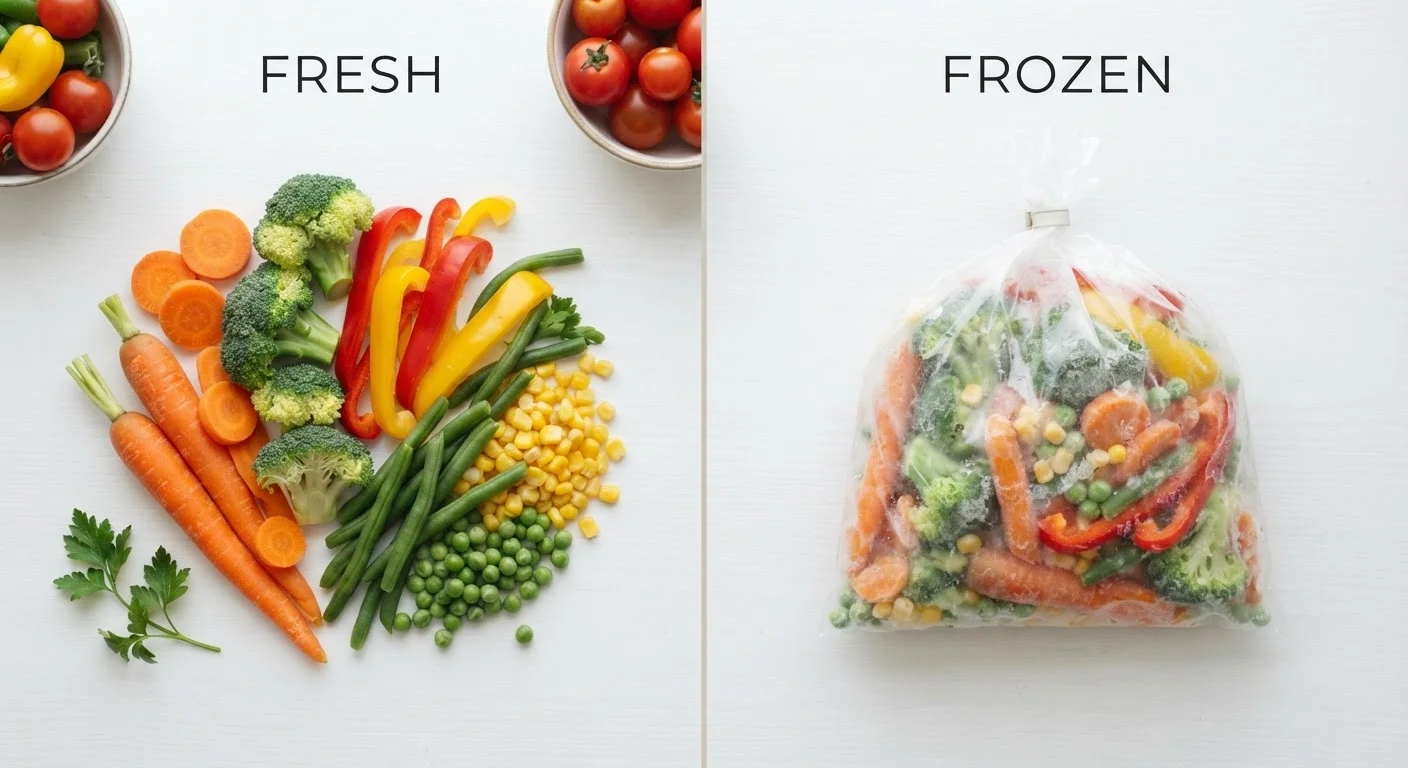
Option A
Fresh produce
The familiar, seasonal choice with a shorter shelf window.
Best for: Families who shop frequently and prioritize texture and variety in seasonal recipes.
Option B
Frozen produce
The long-shelf, cost-stable alternative with locked-in nutrients.
Best for: Families on tight budgets who want reliable nutrition with less food waste.
If your household budget is tight and food waste is a concern
Frozen produce
Frozen vegetables cost less per serving, store for months, and deliver comparable nutrition to fresh, making them a dependable everyday choice.
If you shop multiple times a week and cook seasonally
Fresh produce
When bought in season and used quickly, fresh produce offers good value and suits recipes where texture and presentation matter.
If you want to stretch a single grocery run across two weeks
Frozen produce
Frozen bags last far longer than fresh, so one trip can cover your vegetable needs without spoilage losses.
If you are preparing raw salads or dishes where texture is central
Fresh produce
Freezing changes cell structure in most vegetables, making them softer after thawing, which is not ideal for raw preparations.
What actually happens to nutrients in fresh produce
Fresh produce starts losing certain nutrients the moment it is harvested. Water-soluble vitamins, particularly vitamin C and some B vitamins, are sensitive to heat, light, and time. A 2017 study published in the Journal of Food Composition and Analysis found that some vegetables lost measurable vitamin C during the days between harvest and retail sale. By the time a head of broccoli or a bag of spinach reaches your refrigerator after several days in transit and on a store shelf, its nutrient content may be noticeably lower than at harvest.
This does not mean fresh vegetables are nutritionally poor. Many nutrients, including fiber, potassium, and fat-soluble vitamins like vitamin K, are relatively stable during storage. The concern is narrower: the most fragile vitamins degrade fastest, and the gap between farm and table is often longer than consumers assume.
Buying locally grown, in-season produce and using it within a day or two is one way to narrow that gap. For families who can visit a farmers market or a store with fast product turnover, fresh can be genuinely fresh. For most households buying vegetables that traveled hundreds of miles, the nutrient picture is more complicated. See our guide to nutrition cost myths for more on this topic.
How freezing preserves nutritional value
Commercial freezing uses a process called Individual Quick Freezing (IQF), which rapidly chills vegetables to temperatures below 0 degrees Fahrenheit within minutes of harvest. At this stage, the produce is at or near peak ripeness, so its nutrient content is high. The rapid freeze slows enzymatic activity that would otherwise degrade vitamins.
Research comparing frozen and fresh vegetables has consistently found that frozen options retain vitamin C and other heat-sensitive nutrients as well as, or sometimes better than, their fresh counterparts that have been stored for several days. A widely cited 2017 analysis by researchers at the University of California, Davis found that for several tested vegetables and fruits, frozen samples contained equal or greater levels of key nutrients compared to fresh samples stored for five days.
Freezing does not improve nutrition, but it preserves what is already there at the time of processing. The practical takeaway is that a bag of frozen peas pulled from your freezer three weeks after purchase likely still delivers strong nutritional value.
| Criterion | Fresh produce | Frozen produce |
|---|---|---|
| Nutrient retention | Declines over days post-harvest | Locked in at harvest peak |
| Average cost per serving | Higher, especially off-season | Generally lower year-round |
| Shelf life at home | 3 to 7 days (refrigerated) | 8 to 12 months (frozen) |
| Food waste risk | Higher, spoils quickly | Low, resealable and stable |
| Texture after cooking | Firm, holds shape well | Softer, best in cooked dishes |
| Raw use (salads, etc.) | Works well | Not suitable after thawing |
| Seasonal variety | Wide when in season | Consistent year-round selection |
The cost comparison families should know
Price per serving is where frozen produce often has a clear edge. According to USDA Economic Research Service data, frozen vegetables consistently cost less per edible cup than their fresh equivalents, particularly for items like spinach, broccoli, green beans, and corn. Fresh out-of-season vegetables travel farther, spoil faster, and carry a price markup that reflects those logistics.
Food waste compounds the cost gap. The USDA estimates that American households discard roughly 30 to 40 percent of their food supply. Fresh produce, with its short shelf life, is a major contributor. A $3 bag of fresh spinach that wilts before you use it all effectively costs more per serving than a $2.50 bag of frozen spinach you can reseal and return to the freezer.
For families working with a lean grocery budget, frozen staples like peas, corn, edamame, mixed vegetables, and broccoli florets can anchor multiple meals per week at predictable cost. Our family nutrition primer covers how to build full weekly menus around these types of staples.
30-40%
Food discarded by U.S. households
The USDA estimates American households waste roughly 30 to 40 percent of their food supply, with perishable produce a significant contributor.
Equal or better
Frozen vs. fresh vitamin levels
A 2017 University of California, Davis analysis found frozen vegetables matched or exceeded fresh in key vitamin content after five days of refrigerated storage.
8-12 months
Typical freezer life for vegetables
The USDA Food Safety and Inspection Service notes most frozen vegetables maintain quality for 8 to 12 months when stored at 0 degrees Fahrenheit.
When fresh produce makes practical sense
Fresh vegetables are the better choice in several specific situations. Raw salads and slaws depend on firm, crisp texture that freezing destroys by rupturing cell walls. Dishes where appearance matters, such as crudites or garnishes, need fresh ingredients. And certain produce items, including tomatoes and cucumbers, do not freeze well regardless of preparation method.
Seasonal buying adds another argument for fresh. In-season produce is often priced competitively with frozen, and the quality difference is noticeable. Summer corn, fall squash, and spring asparagus all have seasonal windows when fresh is both affordable and nutritionally dense because it has not traveled far or sat in storage.
The common grocery overspending mistakes article covers how unplanned fresh produce purchases are one of the main ways families quietly inflate their food bills. Buying fresh selectively, rather than as a default, is a straightforward budget adjustment.
This article is for general informational purposes only and does not constitute medical or nutritional advice. Consult a registered dietitian or qualified healthcare professional for guidance specific to your family's health needs.