

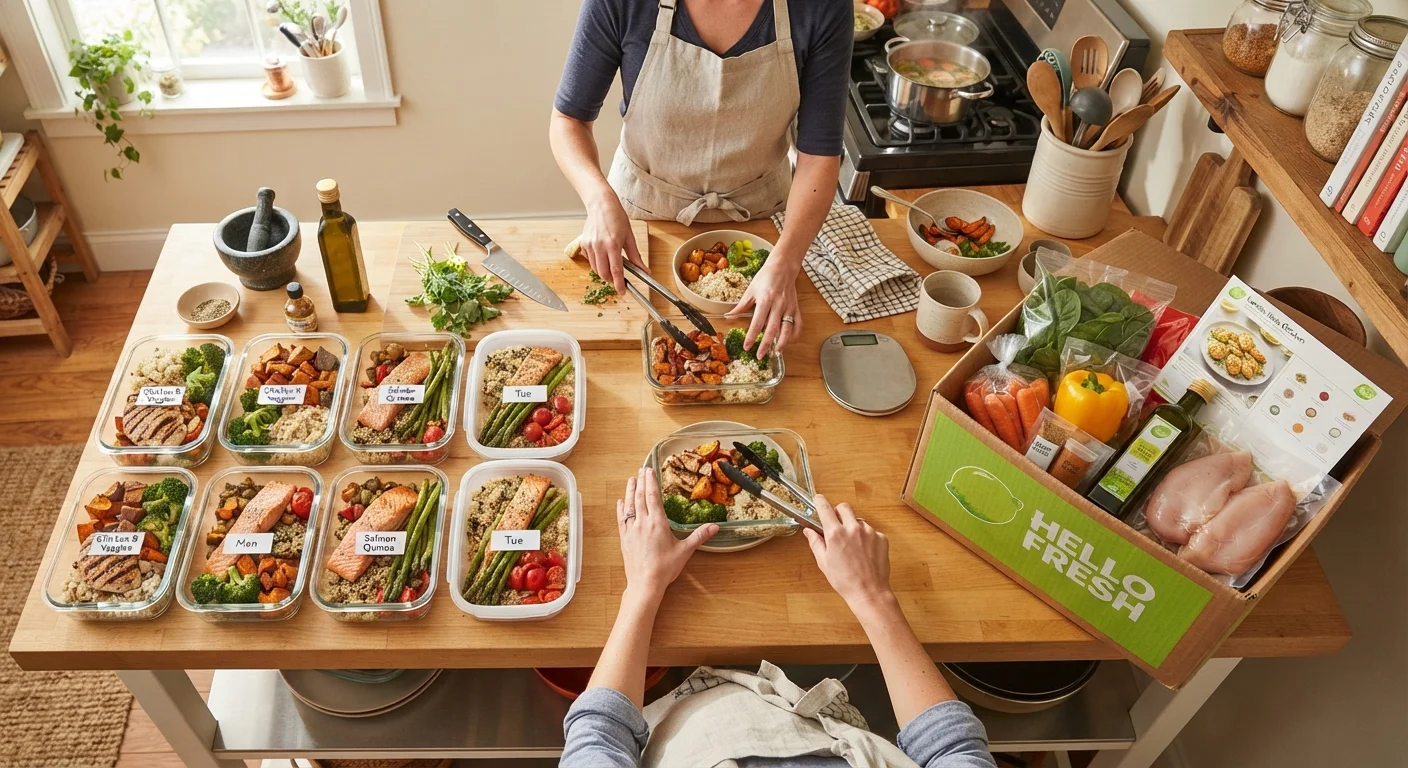
Key Takeaways
Option A
Batch Cooking
The plan-ahead, spend-less approach.
Best for: Families willing to invest a few hours on the weekend to cut weeknight cooking down to reheating and assembling.
Option B
Meal Kits
The structured, low-planning alternative.
Best for: Families who want pre-portioned ingredients and guided recipes without committing to a full Sunday prep session.
If your grocery budget is tight
Batch Cooking
Buying staple ingredients in larger quantities and cooking them yourself keeps per-meal costs well below what meal kits charge, even after factoring in your time.
If weeknight planning is your biggest obstacle
Meal Kits
Meal kits remove the need to plan, shop, and portion, which is the step many busy families skip or get wrong, leading to takeout anyway.
If you want to reduce food waste
Meal Kits
Pre-portioned ingredients mean you buy exactly what a recipe needs, so less produce goes bad mid-week compared to buying in bulk without a firm plan.
If your household has varied tastes or dietary needs
Batch Cooking
Cooking from scratch gives you full control over ingredients, portions, and customization in a way that fixed meal kit menus cannot match.
If you are new to cooking and want structure
Meal Kits
Step-by-step recipe cards and pre-measured ingredients lower the skill barrier, making it easier to get a complete meal on the table without experience.
What each approach actually requires
Batch cooking means setting aside a block of time, typically two to four hours on a weekend, to cook grains, proteins, sauces, and vegetables in volume. You store them in portions and pull them out on busy weeknights. The work front-loads the week rather than spreading it across five evenings.
Meal kits arrive at your door with pre-measured ingredients and a recipe card. You still cook, but you skip grocery shopping, meal planning, and portioning. A typical weeknight meal takes 30 to 45 minutes from box to table. Some services offer oven-ready or partially prepped options that cut that time further.
Both approaches demand something from you. Batch cooking asks for a scheduled prep commitment and organizational discipline. Meal kits ask for a subscription decision, a weekly menu selection, and the willingness to cook on demand. Neither is truly passive. See our balanced look at batch cooking trade-offs for a deeper breakdown of where the approach can backfire.
| Criterion | Batch Cooking | Meal Kits |
|---|---|---|
| Average cost per serving | $2 to $4 | $8 to $12 |
| Weekly time investment | 2 to 4 hours in one block | 30 to 45 min per meal, spread out |
| Grocery shopping required | Yes, weekly | No (delivered) |
| Menu planning required | Yes | Minimal (select from menu) |
| Dietary customization | Full control | Limited to plan options |
| Food waste risk | Medium (bulk buying) | Low (pre-portioned) |
| Packaging waste | Low | Higher per meal |
| Skill required | Moderate (planning + cooking) | Low to moderate (guided recipes) |
The real cost difference
Cost is where the two approaches separate most clearly. Batch cooking from a grocery store typically runs between $2 and $4 per serving for a family meal, depending on ingredients. Meal kits generally run between $8 and $12 per serving, sometimes higher for premium tiers. Over a month, a family of four eating dinner five nights a week could spend $160 to $320 on batch-cooked meals versus $640 to $960 on meal kits. These are general ranges; actual figures vary by location, store, and service.
Meal kit pricing includes convenience, recipe development, portioning, and delivery. Those are real services with real value, but families watching their grocery budget should weigh them carefully. If a meal kit subscription replaces takeout rather than home cooking, the math can look different.
$10+
Typical meal kit cost per serving
Industry pricing surveys consistently place most mainstream meal kit services above $10 per adult serving before any promotional discount.
~$3
Average home-cooked meal cost per serving
The U.S. Bureau of Labor Statistics food expenditure data suggests home-prepared meals average well under $5 per serving for families shopping at standard grocery stores.
30-45 min
Typical meal kit prep time per dinner
Most meal kit services advertise 30 to 45 minutes of active cook time per meal, similar to cooking a moderately involved recipe from scratch.
For a systematic way to track what you actually spend on food each week, the envelope budgeting vs. spreadsheet tracking comparison covers practical methods that work for household food spending too.
Time: where each approach wins and loses
Batch cooking saves time across the week but concentrates effort into one session. If that prep block gets disrupted by a sick child or a full weekend, the whole strategy collapses and you end up ordering out anyway. The system depends on consistency.
Meal kits distribute the effort across weeknights. Each meal takes roughly 30 to 45 minutes, which is comparable to cooking from a recipe you already know. Where meal kits save time is in the grocery trip and the mental load of deciding what to make. For families where decision fatigue drives takeout choices, that reduction in planning friction has a genuine effect.
One practical hybrid: use batch cooking for two or three nights, a meal kit for one or two nights when time is shortest, and keep a simple pantry fallback for the rest. That approach limits kit spending while preserving flexibility. Our weekly meal planning guide shows how to build that kind of structure without overcomplicating it.
Flexibility and family fit
Batch cooking gives you control over every ingredient, which matters for households managing allergies, picky eaters, or specific dietary patterns. You can scale recipes, swap proteins, or adjust seasoning without asking permission from a subscription menu.
Meal kits work well when family members eat roughly the same things and when the weekly menu selections suit everyone. Most services now offer customization within a plan, but the range is still narrower than cooking entirely from scratch. Portion sizes are also fixed, which can be a problem for families with teenagers or varying appetites.
Packaging is worth considering too. Meal kits generate more packaging waste per meal than a standard grocery run. If reducing household waste is a priority, batch cooking from bulk-purchased staples has a lower material footprint.
For context on the broader cost picture of convenience versus scratch cooking, the comparison of processed convenience foods and home cooking provides useful reference points.