

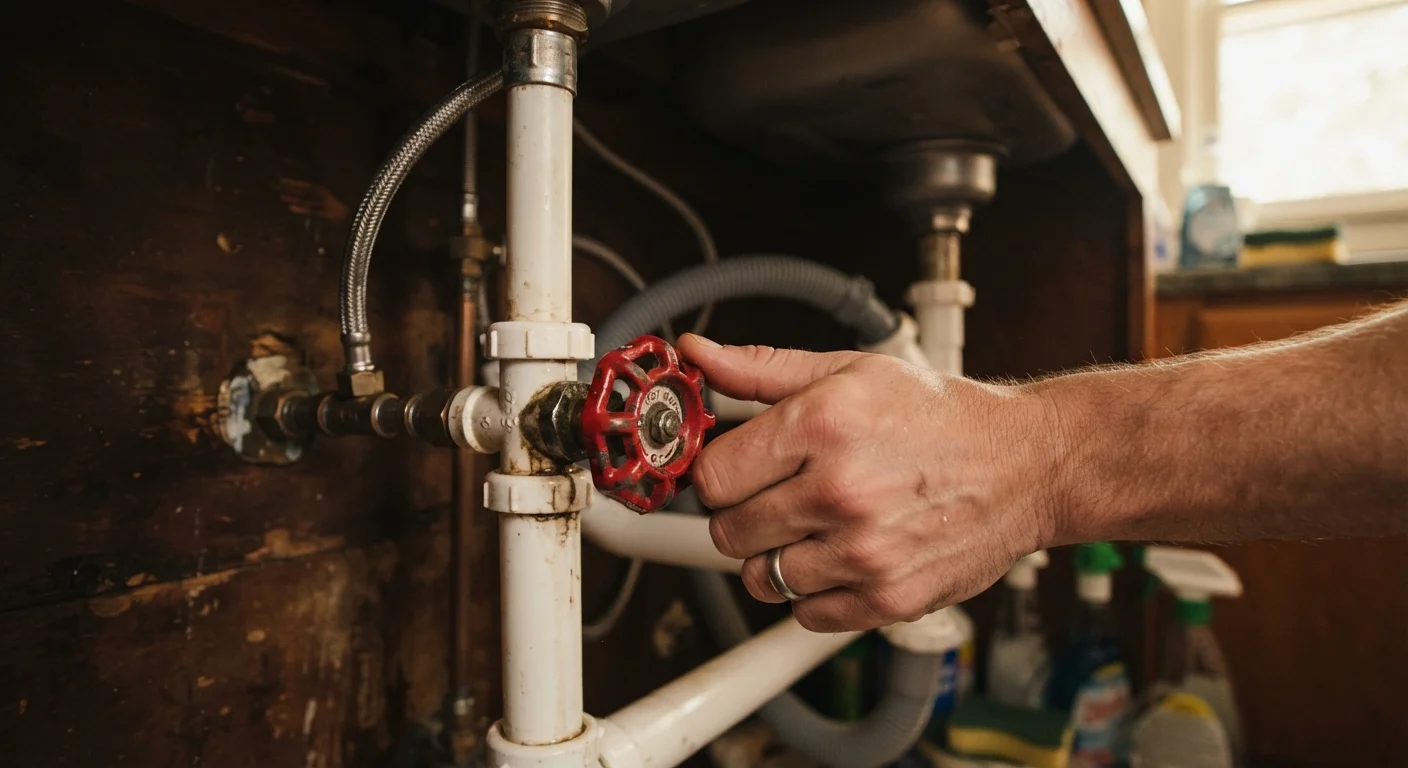
Why shut-off valve locations matter
A burst supply line, a cracked toilet fill valve, or a dripping faucet that won't stop can dump dozens of gallons onto your floors in minutes. The one thing that limits that damage is knowing exactly which valve to turn and where it is. Homeowners who locate and test their shut-off points before an emergency spend far less on repairs than those who hunt for valves while water is already spreading. Even small leaks compound into serious costs when shut-off access is delayed.
Every home has at least two levels of water control: a main shut-off that stops all water entering the building, and individual fixture shut-offs that isolate one sink, toilet, or appliance at a time. Understanding both levels lets you match the response to the problem.
The main shut-off valve
The main shut-off controls all water flow into the house from the municipal supply or a private well. In most single-family homes it sits in one of three places: on the front interior wall of the basement or crawl space closest to the street, inside a utility closet or mechanical room near the water heater, or in an outdoor ground-level box near the property line called a curb stop or meter box. Older homes and apartments often place the valve in a utility room shared with the furnace or water heater.
Two valve types are common. A gate valve has a round wheel-style handle and requires several full rotations to close completely. A ball valve has a lever handle and closes with a quarter-turn. Ball valves are generally more reliable for emergency use because a stuck gate valve can be difficult to operate after years without movement. If yours is a gate valve, turn it slowly once or twice per year to keep it from seizing.
After you find the valve, test it. Turn it fully off, then open a cold tap somewhere in the house. No water should flow within a few seconds. Turn the valve back on fully and check that pressure returns. This confirms the valve actually works before you need it.
Individual fixture shut-offs
Each plumbing fixture in a modern home should have its own shut-off valve, which lets you cut water to just that fixture while the rest of the house stays live. Common locations and configurations include:
- Toilets: an oval or football-shaped valve on the wall or floor behind the tank, on the cold supply line
- Sinks: two valves (hot and cold) under the sink inside the cabinet, on the supply lines rising from the floor or wall
- Washing machine: two valves (hot and cold) on the wall behind or beside the machine, often recessed in a box
- Dishwasher: typically one valve under the kitchen sink on the hot line, or directly behind the unit if it is accessible
- Water heater: a cold-supply valve on the pipe entering the top or side of the tank
- Refrigerator ice maker: a saddle valve or inline valve on the cold supply line under the sink or in the basement ceiling below the kitchen
Fixture valves are almost always quarter-turn ball valves in homes built or replumbed after the mid-1990s. In older homes you may find multi-turn compression or globe valves. Test each fixture valve at least once after moving into a home to confirm it operates.
For a balanced look at when handling these valves yourself makes sense and when it does not, see the honest pros and cons of DIY plumbing fixes.
Mapping and labeling your shut-offs
A simple hand-drawn or printed floor plan with valve locations marked takes about 30 minutes to complete and saves significant time in any plumbing emergency. Walk through every bathroom, the kitchen, the laundry area, the basement, and the utility spaces. Note the location and type of each valve. Once you have the map, tape a copy near the main panel or water heater, and share it with anyone else in the household who might need it.
Labeling valves directly is even more practical. Adhesive pipe labels or durable painter's tape with a marker note work for most locations. At minimum, label the main shut-off clearly so anyone unfamiliar with the home can find it quickly.
Older valves that are difficult to turn, show signs of corrosion, or drip when closed may need replacement. This is straightforward work for a licensed plumber and typically costs less than the water damage a failed valve can cause. Attempting to replace a valve that connects directly to the main supply line without prior shut-off experience carries real risk; if you are uncertain, hire a professional.
Main shut-off valve
A single valve that controls all water entering a home from the supply line. Closing it stops water flow to every fixture and appliance in the building.
Curb stop
A shut-off valve located in a buried box near the street or property line, operated by the utility company or a special key. It sits upstream of the meter and the home's main shut-off.
Ball valve
A valve that uses a rotating ball with a hole through the center to control flow. A quarter-turn of the lever handle opens or closes it fully, making it fast and easy to operate in emergencies.
Gate valve
An older valve type that uses a threaded gate lowered across the pipe to stop flow. It requires multiple full rotations to open or close and can seize if left unused for long periods.
Fixture shut-off
A valve installed on the supply line directly serving one fixture such as a toilet or sink. Closing it isolates that fixture without affecting the rest of the home's water supply.
Supply line
The flexible or rigid tube that carries water from a shut-off valve to a fixture. Supply lines can fail with age and are a common source of under-sink or behind-toilet leaks.