

Key Takeaways
Staying active as a family does not require a gym
A gym membership for a family of four can run $80 to $150 per month at a standard commercial facility, and that figure does not include childcare fees, personal training, or premium class add-ons. For many households, that cost is not sustainable, and it is also not necessary.
Physical activity research published by the U.S. Department of Health and Human Services consistently shows that moderate-intensity movement, regardless of where it happens, produces the health benefits most families are after: better cardiovascular health, improved mood, stronger muscles, and healthier weight management over time. The location is secondary.
The options below cover public spaces, community programs, home-based routines, and travel strategies. They range from completely free to very low-cost, and most require nothing more than time and a willingness to move. For families also working on the nutrition side of household health, the budget-friendly nutrition reference is a useful companion resource.
This is general information, not medical advice
The physical activity suggestions in this article are general educational information. They are not a substitute for guidance from a qualified healthcare provider. Families with members who have chronic health conditions, injuries, or other medical concerns should consult a doctor before starting a new exercise routine. This applies especially to children with developmental considerations and adults with cardiovascular or musculoskeletal conditions.
Use public parks and trails year-round
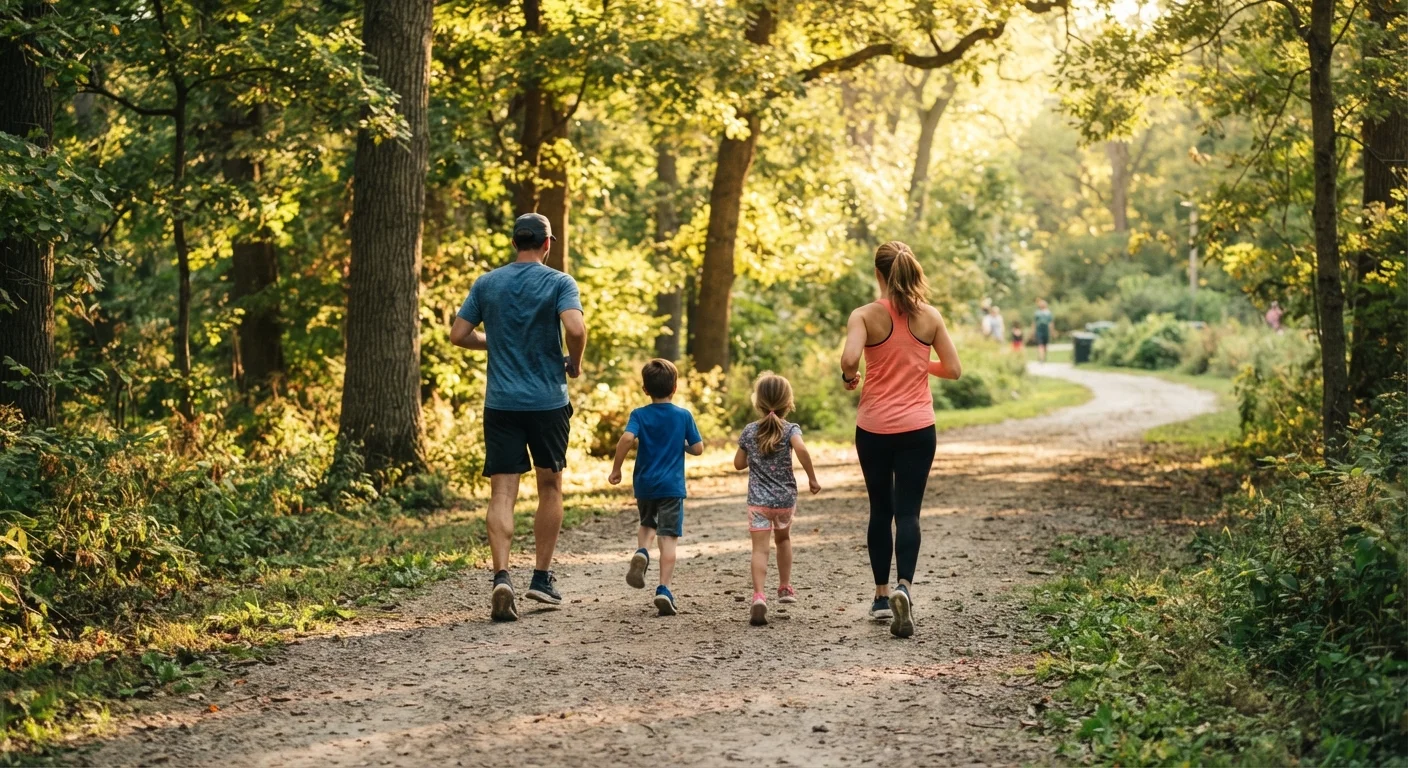
America's network of public parks is one of the most underused fitness resources available to families. Most municipalities maintain walking and running trails, open fields, and playground equipment at no charge. The National Recreation and Park Association notes that roughly 90% of Americans live within 10 minutes of a park.
Structured activities work well in these spaces. Families can set up a simple circuit using benches for step-ups, open grass for sprints, and playground bars for hanging exercises. Hiking nearby nature trails adds variety and works different muscle groups than flat pavement.
Seasonal changes expand the options further. Sledding hills, ice-skating on public ponds, and beach swimming are all weather-dependent but free. Checking local parks and recreation websites for seasonal programs can surface organized events that require no registration fee.
Roughly 90% of Americans live within 10 minutes of a park.
Look into recreation center drop-in rates and sliding-scale fees
Municipal recreation centers often cost far less than commercial gyms, and many offer income-based sliding-scale pricing. A family that qualifies for reduced rates may pay a few dollars per visit rather than a fixed monthly fee. Some centers offer free open-swim hours or family fitness nights on a rotating schedule.
YMCAs operate financial assistance programs specifically for households that cannot afford standard membership rates. The application process varies by branch, but most require basic documentation of household income. Calling the branch directly is the fastest way to learn what is available locally.
These costs can add up quietly alongside other household expenses. The hidden costs article on this site covers how subscription and membership fees often drift higher than families expect, which makes lower-cost public alternatives worth pursuing.
Many YMCAs offer income-based financial assistance that can reduce membership costs substantially.
Search for free community fitness programs
Public libraries, school districts, hospitals, and nonprofit organizations run free fitness programming in most metro areas and many smaller towns. Common offerings include yoga in the park, group walks organized by local health departments, and free youth sports leagues through organizations like Boys and Girls Clubs.
The CDC's Active People, Healthy Nation initiative has helped fund community walking programs and physical activity coalitions across the country. Local health departments sometimes maintain lists of these programs, and community boards on apps like Nextdoor can surface programs that are not widely advertised.
Schools frequently open their gymnasiums, fields, and tracks to community members during non-school hours. Calling the district office to ask about community access policies takes five minutes and can unlock a dedicated space for free.
Local health departments and libraries often maintain lists of free community fitness programs.
Build a home routine with bodyweight exercises
No equipment is required for a complete strength and cardiovascular workout. Bodyweight movements, including squats, lunges, push-ups, planks, and jumping jacks, work all major muscle groups. For families with children, framing these as games or challenges increases participation without requiring instruction or gear.
Free video resources on YouTube cover every fitness level and age group, from toddler movement videos to full adult workout programs. These are genuinely free, not trials or freemium products. Searching for "family fitness YouTube" or "kids exercise YouTube" returns a large selection of options.
A consistent home routine also complements the broader goal of keeping household health costs manageable. Pairing regular movement with affordable whole-food nutrition, as covered in the budget-friendly nutrition reference, addresses two of the biggest drivers of long-term healthcare spending.
Bodyweight routines require no equipment and can be adapted for every age in a household.
Make active transportation part of daily life
Walking or biking to school, the grocery store, or nearby errands converts commute time into exercise time at zero extra cost. The CDC recommends that children and adolescents get at least 60 minutes of physical activity daily; active commuting can cover a meaningful portion of that without requiring a separate workout session.
For families in walkable areas, this approach is straightforward. For those in car-dependent suburbs, identifying one regular trip that is safely walkable or bikeable is a reasonable starting point. Safe Routes to School is a federal program that has worked with thousands of school districts to improve walking and biking infrastructure, and many districts have maps of designated routes available online.
Active transportation also creates consistent, repeatable movement rather than sporadic gym visits, which research in public health consistently links to better long-term adherence to physical activity habits.
Active commuting turns an ordinary daily trip into exercise time with no added cost.
Take advantage of free outdoor recreation during travel
Family trips do not require spending money on amusement parks or guided tours to stay active. National forests, Bureau of Land Management areas, and many state parks offer free or low-cost access to hiking, swimming, and cycling. America's 400-plus national park units charge an annual pass fee of $80, which covers unlimited entry for a household and pays for itself after a couple of visits.
Active travel also stretches the value of a trip further. The free and low-cost activities guide covers genuinely affordable options at popular U.S. destinations, many of which involve walking, cycling, or swimming rather than sedentary sightseeing.
Planning activity-centered itineraries rather than attraction-centered ones generally lowers overall trip cost while keeping everyone moving. The family road trip planning guide has practical strategies for structuring these kinds of trips affordably.
The America the Beautiful annual pass covers unlimited household access to national parks for $80.
Putting it together on a real family schedule
None of these options requires a complete lifestyle overhaul. A practical approach is to pick two or three that fit existing routines, try them for a month, and evaluate before adding more. Families that build physical activity into daily life, through walking, park visits, or active play after dinner, tend to sustain it longer than those who rely on a dedicated gym slot that gets skipped when schedules shift.
Check for free library fitness passes
Many public library systems partner with local museums, nature centers, and recreation facilities to offer free day passes to cardholders. Passes for state parks, aquatic centers, and hiking areas are common. Ask at your branch's information desk or look for a 'museum passes' or 'recreation passes' section on the library's website.
Keeping fitness costs low also keeps health spending predictable, which matters for household budgets that are already stretched. For a broader look at where family budgets quietly leak money, see the hidden household costs overview and the Smart Family Living hub for related practical guidance.
This article is for general informational purposes only and does not constitute medical advice. Consult a qualified healthcare professional before beginning any new exercise program, particularly if any family member has an existing health condition.